
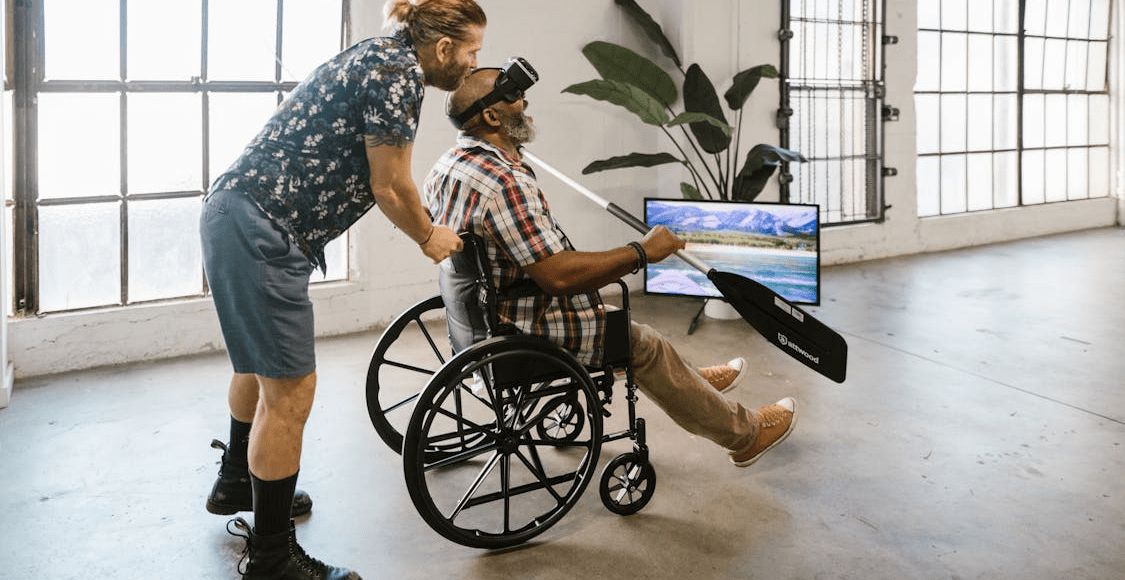

A man, 40, is on a cruise, tall and wide. The winds sing and birds sing back. A calm joyful sunrise greets the man; he smiles and approaches. But too focused on the sun he loses his footing and plumets off the ship. There the ship leaves him alone at sea. Normally he would be terrified, but once he takes off his headset he is once more greeted with a smile, the smile of his therapist.
Many companies claim they can treat mental disorders such as PTSD and phobias through VR therapy. Experts have their reservations. What is definitive however, is that VR is being used to make a change right now.
Psious, founded by Xavier Palomer and Daniel Roig, uses VR to carry out exposure therapy in which clients are exposed to a scenario that they fear, but in a safe VR context. They created the company after discovering evidence that suggested VR could be more effective than traditional treatment.
A notable example of a VR therapy session would be putting a patient in a plane simulation. Despite the environment not appearing real and the patient being fully aware of this, according to Kim Bullock that doesn’t really matter, the experience still trains the brain to face its fears.
“When there’s emotion or fear involved, your brain doesn’t require a completely realistic setting for something to be, for example, frightening,” said Bullock, the founder of Stanford’s Neurobehavioral Clinic.
Daniel Andreev, the CPO of PsyTechVR had a phobia of spiders. But while developing the company’s products, he says, testing the arachnophobia simulation helped him to feel more comfortable with them.
Jimmy Castellanos a veteran, says VR has helped him deal with PTSD. “Before the treatment, 80-90 percent of my dreams were Iraq related. Now I can’t remember the last time I had one. I live in a completely different way now,” said the veteran.
Branch Coslett leads the Neurology VR Lab at the University of Pennsylvania. He says that the work they do there have already shown that VR can have positive effects. “We found that patients had lower ratings of pain, much lower ratings of depression and anxiety, and much lower ratings of failure to interact in the world because of fear of pain.”
A review of research on past clinical uses of VR describes some success in treating a wide range of issues beyond phobias and PTSD such as paranoia, pain, body image, and depression.
However, there are side effects to using VR that casual users may already be familiar with such as cybersickness, which is similar to motion sickness, and the disassociation or even addiction that long sessions might produce. If exposure therapy is not handled carefully by a responsible mental health professional, retraumatization is a possibility. According to Sheehan Phinney over reliance on technologies like VR, for therapy can be a problem. Users can grow too fond of the virtual environment causing them to become more focused on their virtual life without fears rather than their reality with fears they are working on. Because of VR, individualized sessions to suit each patient’s specific needs are possible. This in turn leads to enhanced accessibility.
VR therapy companies are trying to make the content more engaging and user friendly and educating and training therapists on appropriate use.
More needs to be done in this developing field, but researchers are busy taking the steps to achieve their goals, which some suggest will also involve the use of AI. “The real power of AI is when we will put a VR headset on and you’ll see an image of a person or of a clinician or anyone that will look will have the look and feel of a real human being and you’ll interact with him like a real human being,” says Eran Orr, CEO of XRHealth. “Imagine how a psychology treatment will look like 20 years from now.”
Cover Image: Pexels/RDNE Stock project
 8forty.ca
0 comments on “Virtual Reality has the potential to treat many mental illness problems, and yet it may not live up to its hype ”