
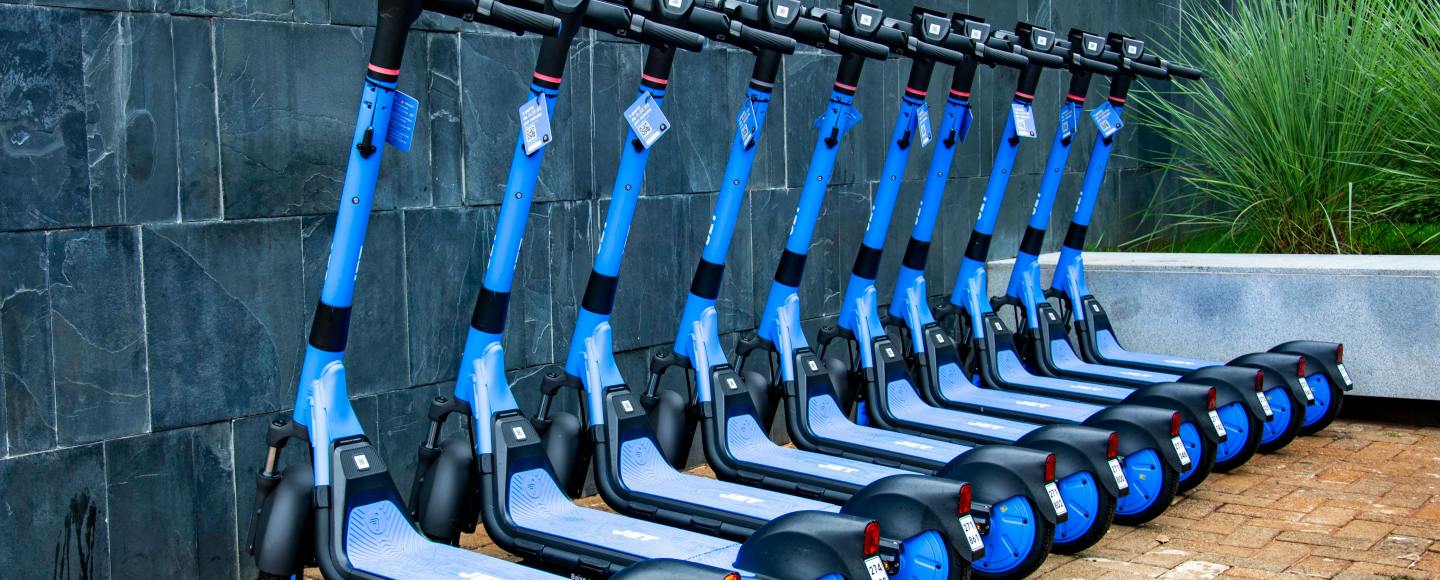

An email sent out to high schoolers in Burnaby stated that e-scooters are banned from riding to and storing at schools due to the fact that Burnaby is not part of the electric kick scooter pilot project.
The electric kick scooter pilot project is a test to see if e-scooters are fit to be driven on public roads whilst following the road laws and regulations created by the specific community. In Burnaby, e-scooters cannot ride on public roads and can only ride on sidewalks, but in participating municipalities, you can only ride on public roads unless signs state otherwise.
“Now I can’t park my e-scooter at the school locks, doesn’t mean I’ll stop riding. This morning, I rode to school and tied it on a light pole half a block away,” said Mateo, an eleventh grader at a school in Burnaby.
This affects many teenagers that use e-scooters to travel almost everywhere they go because now they must know the rules in the places they are and if they’re even allowed to use them.
E-scooters are quickly becoming a staple in North American transportation. They provide quick and convenient ways to get around either owned or rented. With more riders hitting the streets, complaints are rising too.
Both e-scooter drivers and other drivers and pedestrians who spoke to 8forty say there are legitimate concerns about safety and reckless driving.
Companies like Lime and Bird brought e-scooters into cities in bulk to leave on the street available for rental through mobile apps. In 2024, Lime and the city of Vancouver agreed to a five-year contract that only lets Lime provide e-scooter rental services in Vancouver.
At the same time, individuals are buying their own. Brands like Segway and Apollo lead the market in B.C., with the cost of an e-scooter ranging from $400 to over $2000.
However, with more e-scooters being purchased yearly, more roam the streets causing additional congestion. The devices are especially popular among teenagers and young adults. Meanwhile, some people are choosing to switch from cars to e-scooters when making short commutes to save gas money and cut down on emissions. This has led to some communities testing e-scooter riding on streets while other cities don’t allow this.
Communities that don’t participate in the program do not allow e-scooters to ride on public roads, only sidewalks.
But for high school students, riding e-scooters to school will become harder due to the new restrictions set by the Burnaby school district based on the community rules of Burnaby. This disallows any student in high school or lower to ride and park their e-scooters at their schools.
For some, a rise in e-scooter usage might be seen as contributing to a better environment.
“When I first got my e-scooter, I very much enjoyed it,” an eleventh grader at a Burnaby high school, told 8forty. “I would ride it around the neighborhood, take it anywhere I could.”
That changed as the eleventh grader became more self-conscious about the bad reputation that e-scooters get based on a few obnoxious drivers.
“Recently I haven’t been using it. I don’t really intend to use it,” the teen said.
“I think I’ve definitely noticed an increase in the amount of e-scooters, walking down the street, I notice lots of high school kids rolling around.” From his point of view, it can be problematic.
“They’re terrorizing the neighborhood.”
Now, his attitude has completely changed. “People who ride e-scooters are losers!”
He says that scooter drivers are cynical. “These e-scooter kids are screaming and making a lot of noise at night disturbing me and family in my humble home.”
Based on research done by the National Association of City Transportation Officials, usage of e-scooters has been rising consistently since the late 2010s. From a few million trips a year to now where there are tens of millions a year, the rise of dockless e-scooter trips continue to grow every year. With cities becoming more eco-friendly, the growth of e-scooters are inevitable as they transition into regular parts of urban transportation.
Tyson Chow, an eleventh grader in Burnaby who spoke to 8forty believes that there are significant safety concerns around e-scooters.
“They’re very unsafe, I’ve seen lots of people get hurt,” he said. “I know a guy who got hurt and went to the ER from hitting a curb. Also, I notice a lot of riders don’t follow the road rules whether they’re blowing past stop signs or crowding sidewalks.”
E-scooter users may be moving at speeds up to 30 km/h, creating a scenario that results in serious physical damage. With many e-scooter users being students that don’t have licenses, road signs and rules are being broken as per public witnesses, creating a hazard for car drivers and pedestrians on many streets.
“A lot of the users don’t use helmets and it’s very dangerous, I wonder if they do it on purpose or just forget. I think this affects pedestrians too because they could get hurt with no one around which leaves me to help them, but I don’t know what I’m doing,” said Tyson
Some high schoolers elect not to wear helmets when riding on their e-scooters.
“I don’t wear it ’cause they aren’t cool,” one student said.
These risky habits have real consequences. From April 2023 to April 2024, 992 hospitalizations occurred due to e-scooter accidents in Canada based off research done by CBC.
Mateo Believes that e-scooters are great as many people could get around quicker compared to walking.
Mateo says he chooses not to wear a helmet. “I don’t crash,” he explained. “I drive safely and I’ve never fell.”
A parent of a student in Burnaby told 8forty that they are concerned about e-scooter drivers. “They aren’t educated on road rules, I was driving and turning right when an e-scooter ran into my hood. Luckily, she wasn’t hurt and my car wasn’t damaged,” she said.
“E-scooters go way too fast, and they don’t follow road rules.”
Cover Image: Rodolfo Gaion/Pexels
 8forty.ca
0 comments on “E-scooters not welcome on Burnaby streets”