
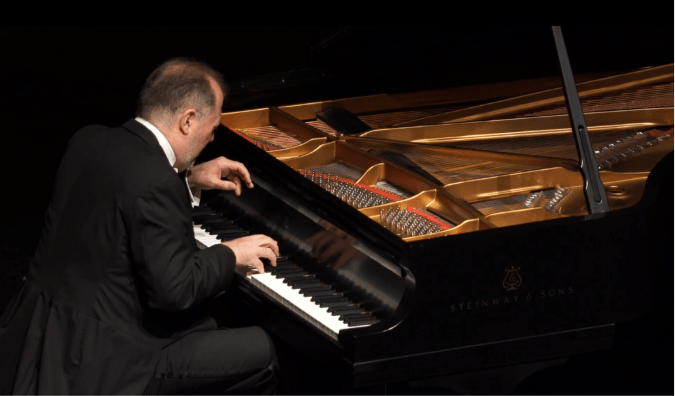

Garrick Ohlsson was 13 when he sat inside Carnegie Hall and heard Arthur Rubinstein perform an all-Chopin program. “I feel like I remember every second of that recital. He began with the F-sharp minor Polonaise, ended with the Ballade No. 1, and I was just entranced…Rubinstein was like sunshine, warm and beautiful, not particularly neurotic, very exciting, but didn’t take you into the dark premises so frequently,” Ohlsson said. That night, a boy found his hero and in time, would become one himself.
Garrick Ohlsson is known as one of the greatest pianists of the 21st century and a principal interpreter of Chopin. His career has spanned over five decades, enlightening the stages of Warsaw, London, New York, Singapore, and more. As the first non-Pole to chair the jury of the recent 2025 Chopin competition in Warsaw, he has struck the classical music world with furious cadenzas and glittering runs.
Ohlsson towers over pianos at 6’3 tall and commands virtuosic pieces under spider-like hands that crawl across the keys. When the lights dim and the audience silence in anticipation of his arrival on stage, he walks on in a most humble manner. Ohlsson nods his head in courtesy and gazes at the audience, his eyes glowing and occasionally mouthing a “thank you” to the crowd. Unlike some pianists that put on a performative show from whipping their heads back in a neck-breaking manner or contorting their faces, Ohlsson conveys emotions through the music itself, never overshadowing with excessive flair.
Ohlsson is best known as a Fryderyk Chopin specialist, not only winning the 1970 International Chopin Piano Competition but also recording the complete works of Chopin, including his nocturnes, mazurkas, and barcarolles. “I do feel a very deep affinity. I have an emotional connection, and a sense of identification with his music perhaps more than any other composer,” Ohlsson said in an interview with Bruce Duffie.
Ohlsson spent three weeks solely immersed on capturing the musical style of Chopin when he competed in the Chopin Competition. The competition is globally recognized since it was established in 1927, taking place in Warsaw, Poland every five years and garnering hundreds of applicants eager to showcase their artistry and gain international recognition. Unlike other piano competitions that have a range of composers like the Van Cliburn International Piano Competition and the Queen Elisabeth Competition, the Chopin Competition only features Chopin. A challenge due to the sheer amount of works that need to be studied and restudied to create an interpretation that respects the structure in Chopin’s compositions “because Chopin himself stands in European music history at the cusp of classicism and romanticism,” Ohlsson explained in an interview.
Ohlsson was 22 years old when he became the first American to win first prize at the Chopin Competition and has come full circle when he was appointed the head of the jury for the 2025 Chopin Competition, the first non-Pole to do so. “I am very honoured by that,” Ohlsson said fondly in an interview with Barbara Rogala, “I’m very happy that I’ve had such an association with Poland and with Chopin that I am considered at least a very familiar friend.”
Still, he routinely returns to Poland to perform recitals and was given the name “bear-butterfly” by Polish critics for playing the polonaise like a bear and the barcarolle like a butterfly.
He recounts the Chopin Competition as if “he can remember every second of it,” and that it was “a very joyous time, intense and joyous,” in an interview with Monika Ścisłowska-Sakowicz. Winning the Chopin Competition opened the doors for record deals and engagements yet Ohlsson still carves out time to teach young pianists and step away from the stage.
Out of the concert hall, Ohlsson dabbles in tennis, swimming, and cooking, though he modestly claims to not be a very good cook. Additionally, his love for the music language extends to spoken language, speaking fluent English, Italian, Spanish, French, German, and some Swedish and Polish.
Ohlsson began formal piano lessons at the Westchester Conservatory of Music in White Plains, New York at the age of eight with Thomas Lishman in 1956. “They enrolled me at the local conservatory, and I was addicted after about two weeks. You couldn’t get me away from the piano. That’s just what I wanted to do,” Ohlsson said. Though he started studying piano late for a professional pianist, he quickly advanced and could play the Chopin études by age 12. “If you can do the Chopin etudes reasonably, you have no need to fear almost anything else that’s ever been written. He’s kind of the Rosetta stone for pianists,” Ohlsson said to ABC Classics.
When Ohlsson was 13, he was accepted into the prestigious Juilliard School and studied with the pianist Sascha Gorodnitzki, who at the time only accepted university level pianists. He would spend hours at the piano, completely absorbed and nuzzled in the pages of his music. “My mother had to chase me outside to play. Then I would come back and want to play the piano. I was a serious kid,” Ohlsson said in an interview.
As an educator, Ohlsson has taught at the San Francisco Conservatory of Music since 1996. Ohlsson related teaching to parenting, saying “it’s a relationship, and each person is different, not only in the level of their playing but in who they are. It’s fascinating and kind of challenging.”
The Chopin Podcast, hosted by Ben Laude and features Ohlsson, is a 12-episode exploration of compositional genres of Chopin premiering in 2024. The pair discussed technical challenges and navigated the intricacies pianist encounter when studying Chopin. “Garrick is both erudite and down-to-earth,” Laude wrote on his website, “and one of the rare concert pianists who can communicate insider-knowledge to a broad audience.”
Indeed, Ohlsson feels the music deep and serves as a bridge between the composer and listeners. “I have no words to express the extent of the range of emotions that Ohlsson makes me feel with his masterful interpretation. My insides are quivering and I have goosebumps,” a listener commented on Ohlsson’s recording of Chopin’s Ballade No. 1 in G minor, Op. 23.
To Ohlsson, music is the biggest privilege in his life.
“I like great music because it’s better than real life although real life is just fine, don’t get me wrong. But there’s a distillation, a sublimity or a happiness, a pleasure or a great sadness. It distills the essence.”
Cover Image: The Cliburn
 8forty.ca
0 comments on “Garrick Ohlsson, the giant that breathes piano ”