
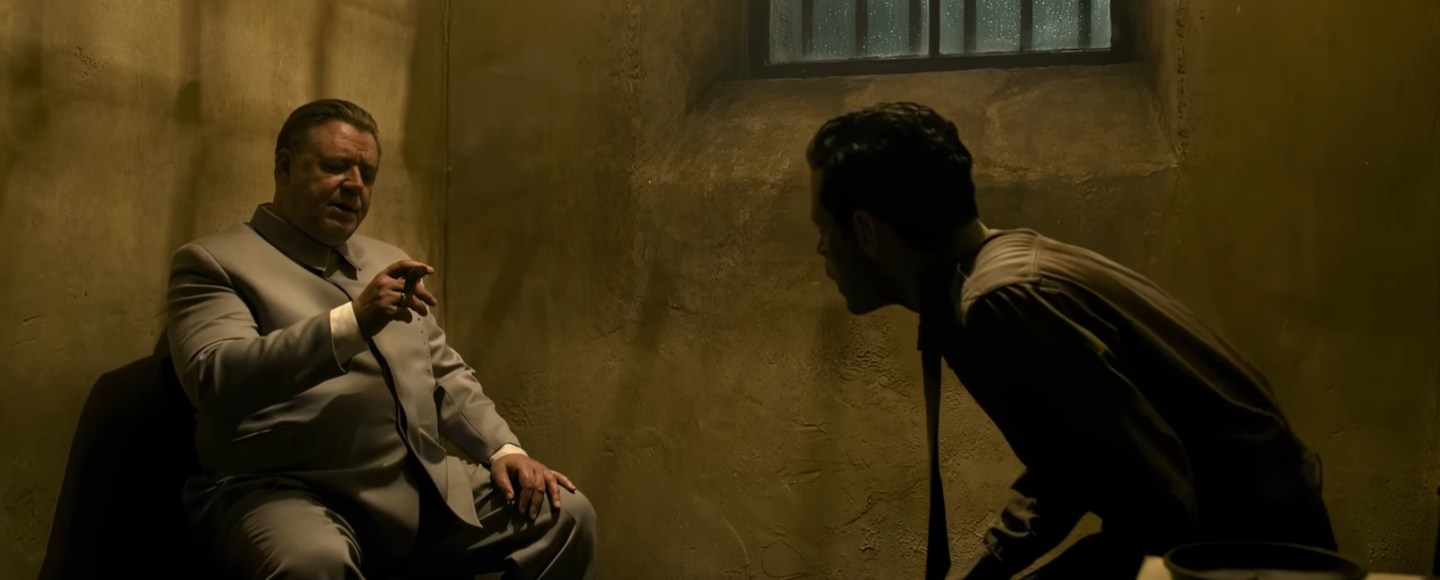

Political thriller Nuremberg, directed by James Vanderbilt takes us 80 years into the past to offer us a courtroom filled with action and an intense pyschological battle between the American psychiatrist, Douglas Kelley (Rami Malik) and the second in command for the Nazi party Herman Göring (Russel Crowe). Based on the Jack El-Hai’s book “The Nazi and the Psychiatrist”. Nuremberg explores one of the darkest periods in modern times, the second world war, and how even the sharpest minds can be manipulated.
The 2025 historical drama film dives deep into the dark and twisted minds of the Nazi party. Douglas Kelley, described as a “hot shot head shrinker” is tasked with examining the Nazi leaders and see if they are fit to stand trial, focusing in particular on Hermann Göring, the second in command in the Nazi party who is portrayed as a cunning and intelligent man.
After his short meeting with Goring, Kelley is infatuated with the “evil” mind and how it comes to be. “If we could psychologically define evil, we could make sure something like this never happens again,” he tells interpreter Howard Triest (Leo Woodall), a Jew who fled the Nazis as a boy to come back in the US uniform. What begins as clinical evaluation transforms into something far more dangerous as Kelley develops an unsettling interest with Göring. The film explores their cat and mouse dynamic as Göring tries to justify Nazi ideology while Kelley struggles to maintain professional distance and even approaches Göring’s wife and daughter.
This movie shows psychological warfare as in one corner we have Kelley who believes himself to be too intelligent to be manipulated, and in the other a man with charm who seduces everyone with his persona. When they first met, Göring was playing everyone by pretending to not know English and therefore gaining the upper hand by carefully thinking about his answers. Kelley on the other hand caught on to it by outwitting him which further shows their cat and mouse dynamic.
The film also makes the audience feel those huge moments, such as when Howard Triest is telling the story of the loss of his loved ones. It did a good job making these big moments feel impactful and important.
However, the pacing was subpar with the actual trial feeling rushed after such a big build up. Not only that but it took about half the movie to start the trial, which is something that will challenge most watchers and test their patience.
It also stumbles on side character development. British counsel, David Maxwell Fife (Richard E. Grant), commandant Burton C. Andrus (John Slattery), and the 21 other Nazi defendants receive minimal development, their presence was there but they could have had more.
On the other hand, what I enjoyed about Nuremberg is how it connects to modern day problems. Göring calls out American hypocrisy: He questioned how the US can take a stand against him for killing especially since they caused the immediate death of 150,000 Japanese people. It’s a deflection tactic many people use. We see many politicians uses this all the time. Instead of answering for their crimes they call out someone else’s.
I also appreciated how they show how easily ethics can be throw out the window under pressure. Kelley is supposed to keep everything Göring tells him confidential as his psychiatrist but when Justice Jackson wants to know what Göring has been telling him in order to help the Justice secure a conviction, he gives it up without much of a fight. He gives up on his morals quite quickly because he starts convincing himself it’s for a good reason.
Overall, Nuremberg is a very straight-forward factual drama that keeps the audience entertained. However, if you are expecting an intense thriller with constant tension or a fast-paced film with the full trial covered, this isn’t the movie for you. It offers a closer look into manipulation, control, and how evil people are often good at hiding their intentions.
What really sticks out is how a story from almost 80 years ago can feel relevant. This film shows how stripping away legal rights, dehumanizing a group of people, and using fear to take away freedom was present in the past. These aren’t just history lessons though; we are seeing the same tactics being used today around the world. Nuremberg revisits justice, power, and morals during one of the darkest periods in modern times and shows us how to learn from it.
 8forty.ca
0 comments on “Nuremberg: Justice Rewritten ”