
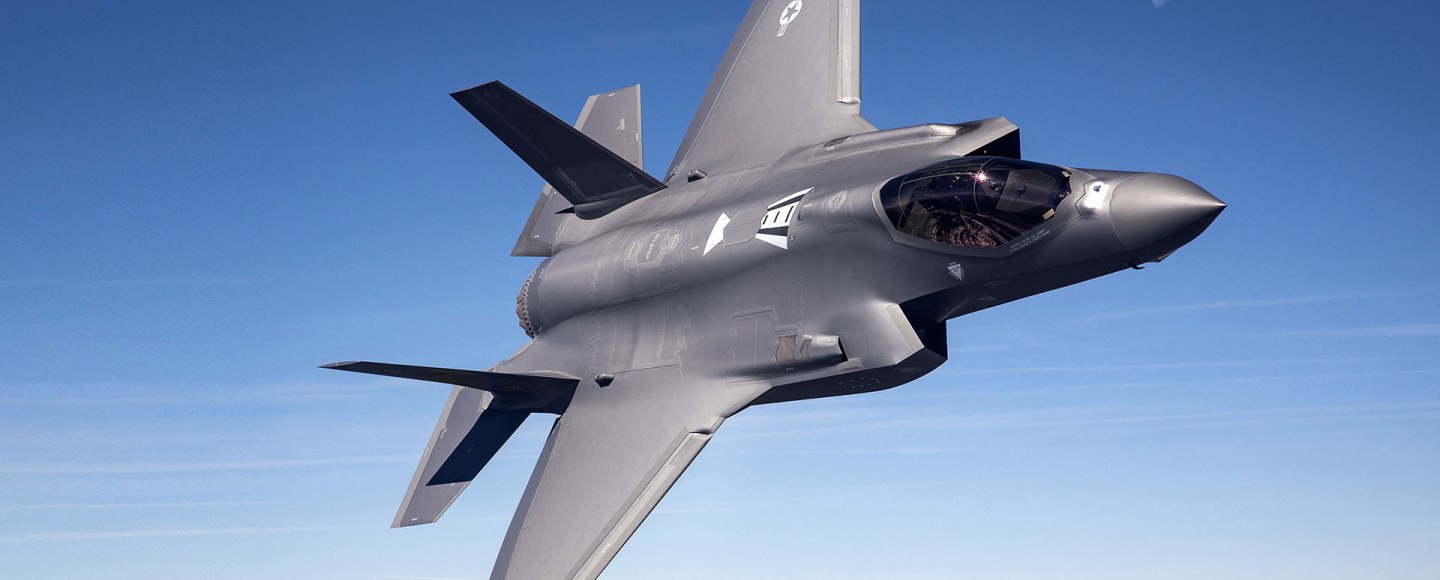

The debate over Canada’s next fighter jet was loud, political, and expensive, but until late 2025, it unfolded without access to the government’s own scoring data.
A confidential fighter jet evaluation completed in 2021 remained out of public view for years. When the internal scoring data was leaked in late 2025, it offered a rare look into how governments assess modern combat aircraft and why one jet emerged with a decisive lead. The documents show that the F-35 Lightning II outperformed its closest rival by a wide margin, reshaping debate around one of the government’s largest defense decisions.
Before the leaked data became public, the government’s fighter jet decision had already been the subject of years of public debate. Critics questioned whether the high cost of the F-35 could be justified, while others argued that alternative aircraft could meet Canada’s defense needs at a lower price. Supporters of the Gripen pointed to its lower purchase cost, promises of domestic industrial benefits, and claims that it was better suited for Canada’s airspace and typical missions.
Much of this debate took place without access to detailed technical evaluations. Public discussion often focused on cost overruns, political considerations, and past controversies surrounding the F-35 program, rather than direct performance comparisons. Without access to internal scoring, it remained unclear how large the capability gap between competing aircraft actually was. As a result, opinions were often shaped more by public messaging and political arguments than by the technical criteria used by military planners.
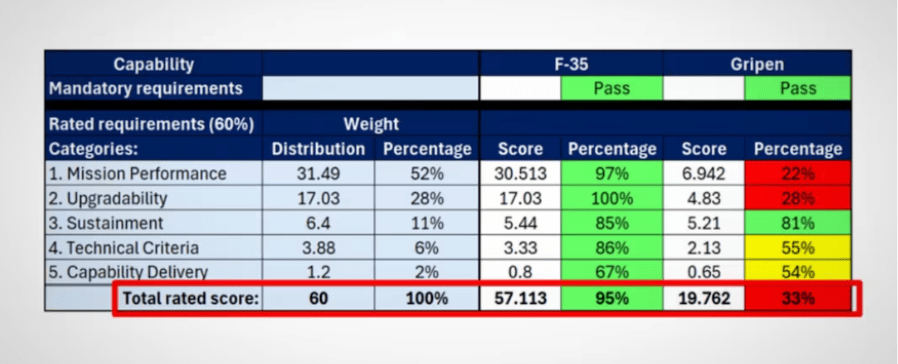
The leaked evaluation compared the F-35 with the JAS 39 Gripen, produced by Sweden-based Saab. Both aircraft met the mandatory requirements needed to qualify for the competition, confirming that each jet satisfied basic operational and safety standards. These requirements, however, served only as a baseline and did not determine the final outcome.
The deciding factor came from the rated requirements, which accounted for 60% of the overall score. These categories were designed to measure long-term military value and included mission performance, upgradability, sustainment, technical criteria, and capability delivery. According to the leaked data, the F-35, developed by Lockheed Martin, consistently scored higher across most of these areas.
Mission performance carried the greatest weight and revealed the largest gap between the two aircraft. Evaluators gave the F-35 high marks for its stealth design, advanced sensors, and ability to operate in heavily defended airspace. The aircraft was assessed not only on its combat power, but also on how effectively it could gather, process, and share information across the battlefield. The Gripen, while recognized for efficiency and reliability, received lower scores in scenarios involving advanced threats.
Upgradability further separated the two competitors. The evaluation highlighted the F-35’s software-driven architecture, which allows new capabilities to be added through updates over time. This flexibility was viewed as a major advantage, particularly as fighter jets are expected to remain in service for decades. The Gripen’s upgrade pathway was rated as more limited in comparison, reducing its long-term growth potential.
In the sustainment category, the difference between the two aircraft was narrower. The data suggested that although the F-35 is more complex, its shared logistics system and international support network helped keep long-term maintenance competitive. Evaluators also considered technical maturity and delivery timelines, with the F-35 scoring higher due to its integration within a large multinational fleet.
When the rated scores were combined, the F-35 achieved roughly 95% of the total available points, compared with about 33% for the Gripen. The size of the gap challenges claims that the competition was closely contested and instead points to a decision driven primarily by technical performance rather than political preference.
The timing of the leaked data has added another layer to the public debate. Although the evaluation was completed in 2021, the data only became public in late 2025, after key procurement decisions had been made. The disclosure has increased pressure on the government to explain how evaluation criteria were applied and how large defense purchases are justified to taxpayers.
It has also fuelled discussion over the government’s fighter jets strategy, including whether to proceed with purchasing a full fleet of 88 F-35 aircraft or to consider a mixed fleet that would include both of the F-35 and the Gripen.
“Do we want a less capable aircraft for Canada?” said Justin Massie, a defence expert at the Université du Québec à Montréal. His comment suggests that, if strengthening national airspace security, choosing the F-35 would offer greater benefits, as it is widely viewed as having stronger capabilities than the Gripen.
By making the technical scoring public, the leak has shifted the debate toward performance, transparency and long-term capability rather than cost alone.
Cover image: Jonathan Case/ Lockheed Martin
 8forty.ca
0 comments on “Leaked evaluation shows F-35 outpaced the Gripen by wide technical margin ”