
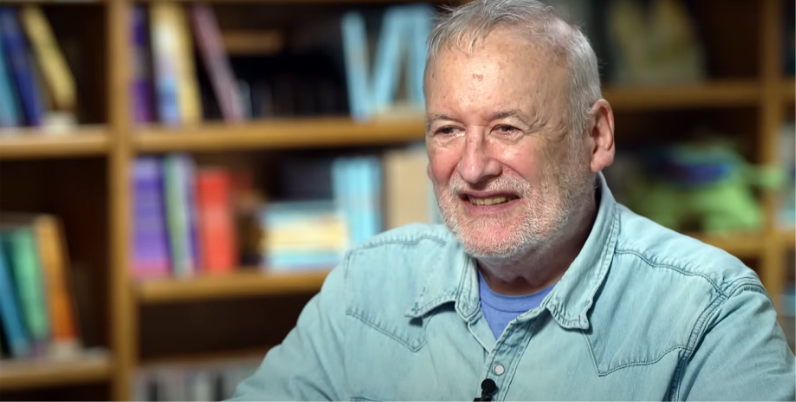

For many families, bedtime ended the same way, a parent’s voice repeating “I’ll love you forever, I’ll like you for always, as long as I’m living, my baby you’ll be.” This line comes from the one of the most famous tales by Robert Munsch, Love you Forever. This classic book and over 100 others fill the bookshelves and hearts of children around the world.
Robert Munsch is a Canadian children’s author known for his unique stories. Throughout his career, he received many national writing awards such as a Juno, an Order of Canada, and a star on Canada’s Walk of Fame. His journey in storytelling was quite unconventional. He didn’t begin writing on a desk, but in daycare and preschool classrooms where he told stories aloud to young children to get them to sleep.
“I discovered that I could get the kids to shut up during nap time by telling them stories,” Munsch wrote on his official website
His interactive and often improvised tales quickly won over both children and adults, building the foundation of his unique storytelling. All the stories are whimsical and fantastic tales that are first told aloud to children, each one inspired by the situation of kids he interacts with.
“The first kid I make up the story for sort of ‘owns’ the story and gets to be the kid in the book” Munsch wrote in his official website.
Munsch published his first book, Mud Puddle, in 1979 launching his career and journey in children’s literature. The book’s success led to several of popular children’s books over the next decades, including classics like The Paper Bag Princess and Love You Forever, which sold millions of copies worldwide and over 80 million copies in North America alone.
Munsch’s stories matter because of the way they make both kids and adults feel. For instance, in The Paper Bag Princess, a feminist favourite, the princess doesn’t end up with the prince like in a classic princess story. Instead, she ends up walking away from the prince completely. For many young readers, this story was their first time seeing a female character choosing independence over a traditional ending. Stories like this challenged the traditional gender norms and shows children that they can do anything.
Another thing that stands out about Munsch compared to most other children’s authors is he doesn’t write to teach or improve a child. Rather than trying to teach lessons, he listens to his audience. “I’m usually listening more to my audience than I’m listening to myself.” Munsch explained in a 1989 profile by the National Council of Teachers of English. “If I was just listening to myself, I’d tend to write stories about adult concerns like acid rain.”
In 1985, Munsch left teaching behind to write full time, but he never stopped performing. He would perform in public-school classrooms, often showing up unannounced and sometimes even staying with the family of the schoolchildren to spark new story ideas. After travelling and finding new inspiration, a story’s plot would eventually settle down and turn into a book.
Munsch’s performances became almost as well-known as his books. His storytelling is very animated and interactive, always including exaggerated expressions, silly voices, and audience participation. During his storytelling, a large range of emotions could be seen throughout the room. For instance, in Love You Forever, one of Munsch’s most famous books, adults would be weeping, and children would be giggling. There was no traditional quiet story time with Munsch which highlights his connection and understanding with the children.
Recently, Munsch has been very open about his health problems. In 2008, Munsch suffered a stroke, causing him to forget many of his stories. He started seeing a speech therapist, which later allowed him to continue to perform at schools. In 2021, Munsch announced that he was diagnosed with both dementia and Parkinson’s disease. Previous experiences of watching his brother die slowly caused him to decide on a medically assisted death (MAID), which he received approval for in September 2025.
However, while Munsch is growing old, there is no date set for his death. “My father IS NOT DYING!!!”, said a post made by Munsch’s daughter. “Thanks to everyone and their well wishes, however, my father’s choice to use MAID was in fact made 5 years ago, this is not new news and it was discussed in an interview with the CBC in 2021.”
Even though Munsch can’t perform anymore, he still takes on many interviews. This really shows how his career isn’t just writing books but connecting with his audience. In a recent interview with the New York Times, Munsch reveals that he is unable to come up with new stories. “Plots used to just appear to him, all the time and almost fully formed, as if they were limitless. But now they don’t” reported the New York Times.
Despite this, Munsch believes that his stories will live on to reach future generations.
“There’s about 50 stories,” Munsch said in a recent interview with CBC. “When I’m dead, they’ll still be putting out Robert Munsch books.”
Robert Munsch’s legacy will live on long after he’s gone, carrying the joy of his books through generations.
Cover Image: CBC News: The National
 8forty.ca
0 comments on “Robert Munsch’s legacy will live on for generations through his unique and interactive stories”