
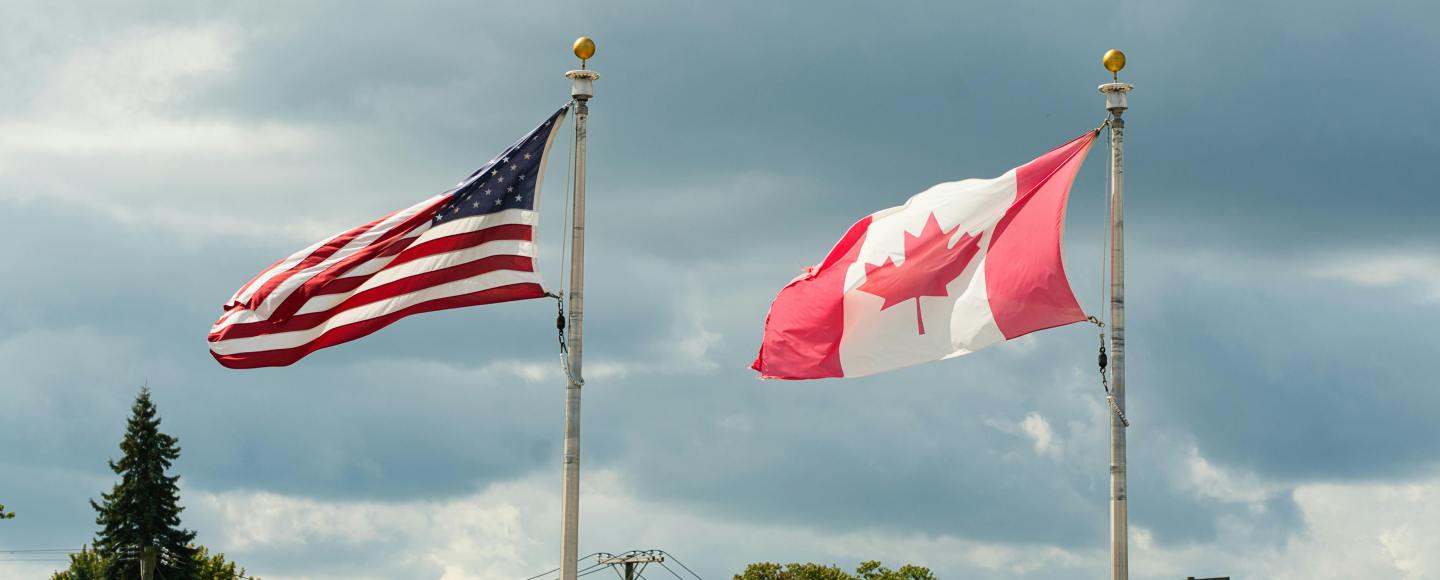

Since Donald Trump came into office, he has instituted tariffs on over 90 countries and territories, including its neighbour and second-largest trading partner, Canada.
The Canadian-US trade war has created pressure on small businesses throughout Canada. For these small businesses, US tariffs and Canadian counter-tariffs have raised prices on goods, shrunken profit margins and threatened the possibility of expanding or growing their brand.
On January 20th, Donald Trump took office for his second term as President of the United States of America and his mission was clear, he wanted the United States to be more independent and not rely on other countries like China, Canada and Mexico. On February 1st, President Trump signed three executive orders putting a 10% tariff on all Chinese goods and a 25% tariff on goods from Canada and Mexico, except for Canadian oil and energy which only received a 10% tariff.
Trump said to a BBC reporter that this was done to increase the amount of tax gained by the government, influence Americans to buy more American-made products and to boost investment in the US.
On March 4th Canada responded to these tariffs with some of their own. Canada imposed 25% tariff on curtain aluminum, steel, and auto parts and products, as well as a 25% tariff on a variety of US goods.
The Former Prime Minister Justin Trudeau did this “Tariffs will disrupt an incredibly successful trading relationship. They will violate the very trade agreement that was negotiated by President Trump in his last term.”
Over the following months, the US responded with further tariffs still.
In April, the US implemented a 25% tariff on all auto parts, in August they put instituted a 50% tariff on copper, and in October, Canadian lumber was hit with a 10% tariff.
With tariffs being thrown around between the two countries, small businesses have been caught in the cross fire.
Troyhann Santos owns a sports store in Ontario Canada called the Lax Shack has been hit hard with the Canadian counter-tariffs. “To get hit with something like this is terrifying,” said Santos to a CBC reporter, “it’s a terrible gut punch.” Santos gets almost all of the lacrosse nets, balls and sticks imported from the US. Because of this, Santos says, “We’re going to have to increase our prices to reflect that 25 per cent increase.”
Santos has mixed feelings about the Canadian counter-tariffs. “I want Canada to stand up for themselves,” she told the CBC, but on the other hand, “these increases in prices also hurt.”
Troyhann Santos and the Lax Shack aren’t the only small business in Ontario worrying about the affect’s tariffs. Raza Hashim owns a small fast-food chain called Cluck Clucks in the Toronto area, which he says could be affected by the Canadian counter tariffs.
Hashim told the CBC that the Canadian counter tariffs won’t affect their sales or the income that they are already making, but it could affect the expansion of the franchise. Each location must have 6-8 deep fryers that cost up to $27000 each. All the fryers are made from steel that is imported from the US and because Canada’s counter tariffs include appliances made of steel, they will have to spend 25 per cent more on each fryer.
“We’re expecting our costs to go up significantly,” said the CEO of the company Raza Hashim “So, overall, just not a good situation for us.”
Even though the Canadian counter-tariffs are affecting the growth of the small franchise, Hashim and Cluck Clucks are in full support. “It is for the good of the entire country,” said Hashim. “As a citizen, as a naturalized citizen, we will bite the bullet for our adopted country.”
The Lax Shack and Cluck Clucks are not the only businesses with uncertainty about the future of their businesses. The Canadian Federation of Independent Businesses (CFIB) has said that “one in five (19%) small businesses dealing with extra tariff costs report that they will not be able to last more than six months if the tariff status quo remains.” 59% of independent businesses say that the tariffs on aluminum and steel are affecting them in a negative way, and 58% say that Canada’s retaliatory tariffs on USA goods have.
In early September some changes were made to both sides of this trade war. On September 1st Canada officially removed almost all their counter-tariffs against the United States. In a short video, Carney talked about how the US had “reaffirmed a core commitment to our free trade agreement, CUSMA”. Carney continued by saying this means the actual US tariff rate on Canada is new only 5.6% which is much lower than the 16% average globally. Canada dropped almost all their retaliatory tariffs to match the USA’s tariffs to further negotiate the peace trade deal and recreate the CUSMA agreement.
Another reason for the cancellation of the Canadian Counter-tariffs is the cost of living. Since the day that Canada imposed counter-tariffs on the United States, lots of different products and services have skyrocketed in price such as gasoline, foods and beverages like Berries, Different Nuts and orange juice.
On the other side, President Trump announced in late September that he was considering putting a 100% tariff on all foreign made movies. “Our movie making business has been stolen from the United States of America by other countries” wrote the President on social media. “Therefore, in order to solve this long-time, never-ending problem, I will be imposing a 100% Tariff on any and all movies that are made outside of the United States.”
While this is potentially concerning for the Canadian film industry, it may be a difficult tariff to enforce as films do not need to be physically imported. Donald Trump’s promise about these tariffs still has not come into effect, and he has not talked much about them since.
According to information from Statistics Canada through CBC news, in the past year, Canada have slowed down their trades with United States of America and started relying on more countries in Asia and Europe.
Cover Image: Pexels/Thomas k.
 8forty.ca
Great writing here bubba! Hope to see more in the future!!
LikeLike