

Politics have always affected the world of sports, and this year’s FIFA World Cup has been no exception.
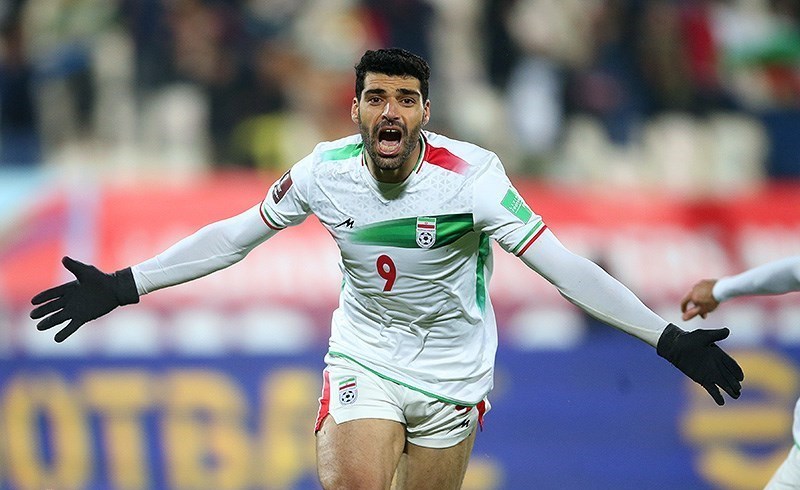
Iran’s national football team has been cleared by its own government to compete at the 2026 FIFA World Cup this summer, but some Iranian players could possibly miss out for having ties to the Islamic Revolutionary Guard Corps (IRGC).
Government spokesperson Fetemeh Mohajerani told state broadcaster IRIB that the Ministry of Youth and Sports made all necessary arrangements for the team’s participation. But Iranian Football Federation president Mehdi Taj acknowledged the situation remains delicate.
“We are preparing and making arrangements for the World Cup,” Taj said, “but we are obedient to the decisions of the authorities.”
Iran is among the countries subject to a full entry ban under two travel restriction proclamations issued by the Trump administration last year, which limit the entry of nationals from 39 countries into the United States. The only exception covers athletes, coaches and their immediate relatives traveling for major international competitions. Journalists, friends, and fans remain banned.
Washington has no objection to Iranian players competing, said Marco Rubio, the US Secretary of state. But he made clear the exemption has limits.
“Nothing from the US has told them they can’t come,” Rubio told reporters. “The problem with Iran would be not their athletes. It would be some of the other people they would want to bring with them, some of whom have ties to the IRGC.”
The Iranian football federation has also confirmed that some players may be denied US visas because of military service backgrounds. Mehdi Taj stated that a visa had already been refused for Saeed Alhoei, a member of the coaching staff, and that the federation had begun preparing replacement options for any player who might face the same problem.
“If for any reason they tell a player not to come, we must have replacements,” Taj said. “We have already started this process.”
Reported by Ashley Burke, Mehdi Taj himself had been refused entry into Canada for FIFA’s Congress event for his links to the Islamic Revolutionary Guard Corps. The former intelligence commander and his group were later granted visas to enter, but questioned by the Canadian Border Services Agency once they arrived in Toronto. FIFA later expressed regret over the incident and arranged a separate meeting with Iranian officials.
Iran formally requested that FIFA move all three of its group stage games, against New Zealand, Belgium, and Egypt, from US venues to Mexico, where World Cup matches are also being held. Mexican President Claudia Sheinbaum confirmed the request was rejected. The games will remain in the United States.
Iran’s Foreign Ministry spokesperson Esmail Baghaei said FIFA has an obligation to step in.
“Host governments have a very clear obligation under FIFA regulations to provide the necessary arrangments and issue the required visas without taking political considerations or motives into account,” Baghaei said. “We hope FIFA, if only for the sake of preserving its own credibility, will certainly take the necessary measures.”
“It is offensive for any football fan to be prevented from participating in the World Cup, not just Iranians,” said Ali Rezaei, a journalist with Tehran’s Borna news agency.
FIFA President Gianni Infantino has insisted Iran will participate.
He visited the team at their training camp in Antalya, Turkey, and said publicly that the players made clear they want to compete.
“Of course, Iran will be participating at the FIFA World Cup 2026,” Infantino said at the FIFA Congress in Vancouver. “Of course, Iran will play in the United States of America and the reason for that is very simple because, dear friends, we have to unite. We have to bring the people together. Football unites the world.”
Infantino is also reportedly seeking a prohibition on ICE enforcement operations during the tournament, similar to informal arrangement that was in place during last summer’s Club World Cup
Trump’s position has shifted since the controversy first drew attention. In March, he said he “really didn’t care” whether Iran participated and suggest the team might not be safe in the United States. After Infantino addressed the matter publicly at the FIFA Congress, Trump change course.
“Well if Gianni said it I’m OK,” Trump said. “You know what, let them play.”
The players themselves have continued training through uncertainty. The squad launched a camp in Tehran on April 20 and is set to travel to Turkey on May 12, where foreign players will join the group for three more friendlies. Iran is required by FIFA to arrive at its base in Tucson, Arizona no later than June 10, five days before its opening game at SoFi Stadium in Los Angeles on June 15.
The standoff between the US government and Iran over World Cup access resembles a situation from Trump’s first term in office. In February 2017, after Trump signed an executive order banning visas for nationals from seven Muslim-majority countries including Iran, Iran retaliated by prohibiting US wrestlers from competing at the Freestyle World Cup in the Iranian city of Kermanshah.
The American squad at the time was to include Kyle Snyder, who won gold at the Rio Olympics, and Jordan Burroughs, a four-time world champion and 2012 gold medalist.
“These decisions, these executive decisions, are always for far beyond your reach,” Burroughs said. “You always feel like, ‘Well, the presidency or these strict laws, they’ll never affect me.’ This is one of the few times where something so personal has occurred.”
Rich Bender, the executive director of USA Wrestling, said the ban came as a blow despite assurance the team had found out through back channels.
“I’m disappointed for the wrestlers who have been working for this and now won’t have this opportunity,” Bender said. “We were hoping politics wouldn’t have this kind of impact, but apparently that has been the case.”
The ban was reversed days later after a US federal court blocked Trump’s travel restrictions, and both wrestling federations pushed their governments for a resolution. The athletes competed, but the situation served as a reminder that in US-Iran sporting relations, assurance means nearly nothing.
The circumstance today is far larger, with an entire World Cup squad and millions of fans affected rather than a single wrestling team. But the core issue remains the same.
For now, the ball is no longer on the pitch. It sits in the hands of politicians who have never laced a boot, deciding the fate of athletes who have spent their entire life working toward this moment.
Image credit: Meghdad Madadi – Tasnim News Agency
 8forty.ca
0 comments on “Iran “Fully prepared” for the World Cup – but IRGC ties could set them back”