
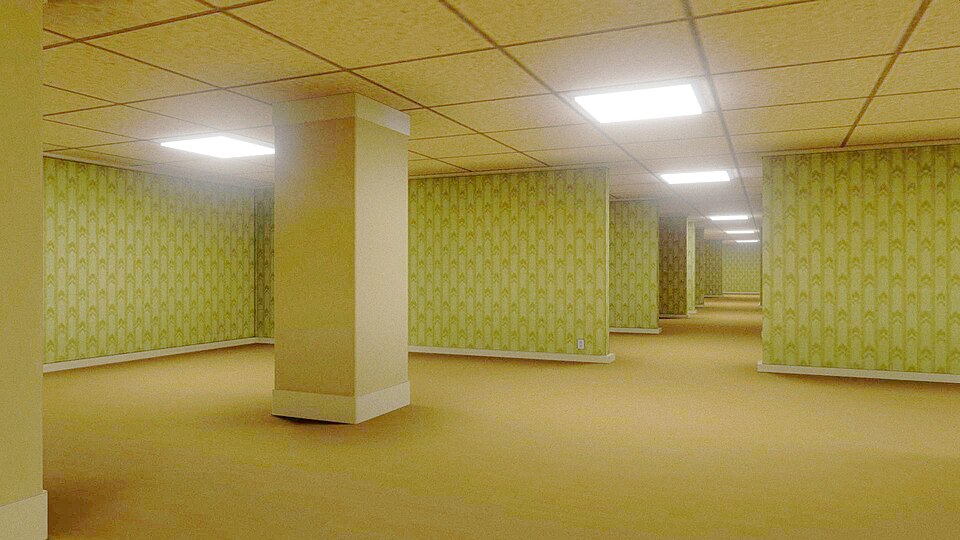

In 2019, an anonymous 4Chan user posted an uncanny image of a room with a pale shade of monochrome yellow, a tint of fluorescent lighting that illuminated the room, old stained carpets, and detailed wallpaper used in urban homes from the 70s.
It surged in popularity right away with it blowing up with likes, comments, and the number of ideas of what users could make or create out of it. Many people pointed out that it seemed empty, eerie, uneasy, or sometimes even nostalgic. “This is what happens when you “no-clip” out of reality,” a user wrote.
The meme came to be known as “The Backrooms” –little more than a parade of eerie images of strange empty spaces.
Now it’s no longer a viral image sharing trend—it’s a Hollywood film.
Produced by movie production studio A24 with a budget of only 10 million dollars, The Backrooms is a psychological horror film with a worldwide release on May 29.
It is a fitting transition for a meme that was already influenced by visual storytelling. The Backrooms found its most powerful visual form through the analog horror genre, a style that comes from grainy, degraded VHS video. The style mimics those old VHS recordings, surveillance footage, and retro aesthetics to create realism and unease.
Starting in 2022, Kane Parsons, one of the most influential creators in this space, brought the Backrooms to life through a series of short films on YouTube. His videos used handheld camera work, realistic motion, and subtle visual effects to make the backrooms feel eerily realistic, immersive, and disturbingly real.
Now he has become the youngest feature film director to direct a major studio film.
Parson’s interpretation avoids over-explaining the lore and instead focuses on immersion. Viewers experience the confusion and fear of someone being trapped inside the Backrooms rather than being told what it really is.
What made the original meme so compelling was its obscurity. There were no monsters at first: just isolation that makes you feel that you’re being watched at every corner, repetition of rooms and halls and the uncanny feeling of being somewhere familiar like a Deja vu. This sets us into a psychological concept often referred to as “liminal spaces”, environments that feel transitional, abandoned, or frozen in time.
As ideas spread, online communities expanded the concept. The Backrooms became a vast, layered universe with multiple “levels,” entities, survival rules, and lore. It transformed a single creepy idea into a collaborative storytelling project shaped by thousands of contributors across forums and webs.
An example of a story across the web includes one of the most famous sights of the Backrooms: Level 0. Also known as the Lobby, Level 0 is located in a vacant office building. From theories online, each level created is limitless with no end to space. The way to escape is to locate the exit of each room. Then you can advance. But be careful of the monster at each level. These monsters are uniquely connected to the theme of the level, while some monsters could be friendly, some could be hostile.
Many internet myths like the Backrooms have been adapted and produced into movies, such as Slenderman in 2018 and Exit 8 in 2026.
The viral success of Parsons’ YouTube work on the Backrooms caught Hollywood’s attention. In 2023, it was announced that a feature film adaptation of the Backrooms was in development, with Parsons as director, an unusual move that showed a shift in how studios view internet creators as to being ones who can create and direct content.
To make the film successful, Parson’s needed to expand the Backrooms concept while preserving the key core strengths like atmosphere over exposition, psychological horror over traditional jumpscares and a sense of infinite, unknowable space.
Unlike many adaptations, the challenge is not summarizing a detailed story: it’s building one without losing the mystery that made the original idea compelling.
Why the setting is mysterious, Parsons wanted it to be as realistic as possible.
“The set was huge. We built 30,000 square feet of actual backrooms that we could walk around in” said Parsons. That is over half of an NFL football field. Many employees on set reportedly got lost in the vast space of meandering almost identical rooms.
The Backrooms stands out because it reflects a uniquely modern fear. It’s not about ghosts nor monsters in a traditional sense, it’s about being lost in a system you don’t understand, with no directions or tips on what to do. Add it with endless repetition, universal rules, artificial environments like office & malls, and the Backrooms feel eerily believable. It stands out unique, nothing we’ve seen before in horror movies to this day.
 8forty.ca
0 comments on “Backrooms: How a single viral image led to a $10 million dollar feature film ”