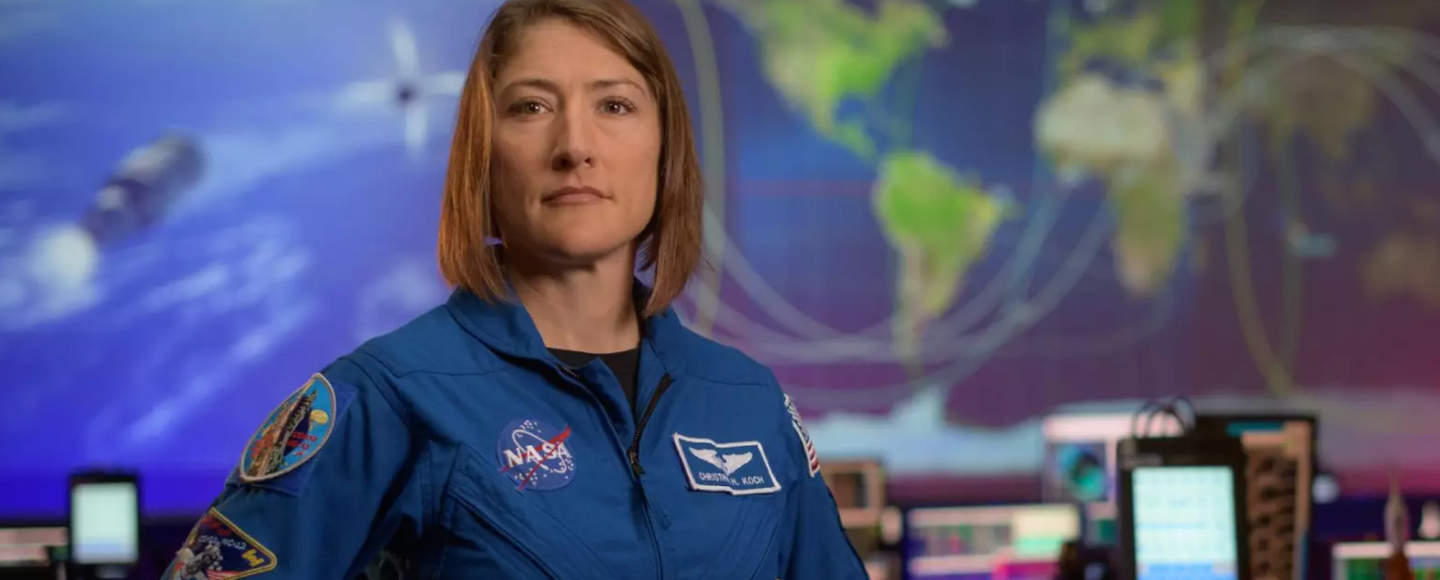
Perhaps you’ve stood outside at night, looking up at the endless sky and wondering what it would be like to float among the stars far above earth. For Christina Koch, that’s not just a dream; she actually lived it.
If you followed the Artemis II mission which sent astronauts around the moon and back, you’ve probably heard the name Christina Koch. She’s one of the astronauts making history right now. From years living aboard the International Space Station, to helping bring humanity’s return to the moon, she’s become a significant piece in NASA’s next step of interstellar exploration.
Koch was training for extreme environments long before she became an astronaut. She worked in places like Antarctica as a research associate, where the cold, isolation, and harsh conditions helped prepare her for something even more intense: space. She has described Antarctica as “otherworldly”. The tough terrain, remote location, freezing temperatures, and months of darkness at a time feels an awful lot like space, she says.Reflecting on the extreme environments like Antarctica,
She studied electrical engineering and physics at North Carolina State University. During her studies she became involved in research projects that focused on space, which helped set the foundation for her future career.
In 2013, she was selected as one of the eight members of the 21st NASA astronaut class. And in 2018, she was assigned to her first space flight. The assignment directly led to her launch in March 2019, where she spent almost a full year in space living and working in microgravity. During this mission, she adapted to the isolation and physical challenges of micro–gravity, which was crucial for her future missions.
At this time, she completed hundreds of scientific experiments which contributed significantly to vital research and as well became part of history by participating in the first all-female spacewalks. She stepped outside the safety of the station to work in the vacuum of space. For many people watching on earth, that moment became a symbol of how much space exploration had changed – and who it included.
Additionally, during this mission, she made another very impressive achievement, setting the record for the longest single spaceflight by a woman, spending about 328 consecutive days in space. She has said in pastinterviews that the experience helped her understand both the physical limits of the human body and the mental strength required for long missions, especially those beyond earth orbit. Reflecting on her time in space, Koch explained that “the human body remains robust and resilient” even after long periods away from Earth.
One of the biggest challenges Koch faced during her time in space wasn’t just the physical strain as we would expect, but the mental and emotional side of being away from Earth for that long. Living aboard the International Space Station meant being separated from family, missing major events, and adjusting to a completely different sense of time and routine. Koch has spoken about the importance of staying mentally grounded during long missions in space. Talking about her time aboard the International Space Station, she explained how astronauts gradually adapt to life in orbit and develop a sense of normalcy despite the extreme environment.
“It starts to feel like home,” Koch said during a NASA news conference, talking about living aboard the station. “I would say only about three months in is when I started to sort of feel at home there, the different things that we do throughout our daily life seemed normal to me.”
Expanding on the mental side of spaceflight, Koch has also noted the psychological challenges of space, saying “Spaceflight challenges you mentally just as much as physically.”
That ability to stay resilient is a big part of what made her so successful during her record-breaking mission. Those key traits continue to be a model for astronauts preparing for even longer journeys in the future.
Then came her next leap.
Koch became part of NASA’s Artemis program, with the goal of returning humans to the moon and eventually traveling deeper into space. She was selected for Artemis II. In April 2026, she became the first woman to travel beyond low Earth orbit and fly around the moon, marking a major milestone in human space exploration.
“We are going farther than we’ve ever gone before,” Koch said
In terms of the future, Christina has a couple goals in mind. As a veteran of the Artemis II mission, which tested critical life support and navigation systems, Koch said she hopes the mission will help pave the way for future lunar exploration, including landing the first woman on the Moon. Thinking on her role in the program, just days before liftoff in April 2026, she spoke on the journey ahead as “an immense sense of honor and responsibility,” the world air sports federation reported.
Koch has said she hopes to inspire younger generations to pursue careers in science and space exploration. She frequently speaks with students and participates in educational outreach programs through NASA.
“Do what scares you” has become one of Koch’s signature messages. During a 2023 discussion about the Artemis II mission, she encouraged students to pursue goals that may feel intimidating rather than choosing the easiest path.
Koch has often emphasized that achievements in space exploration matter most when they create opportunities for future generations to go even farther.
“My number one hope for this milestone,” she said in a press conference, “is that the record is exceeded again as soon as possible, because that means that we’re continuing to push the boundaries.”
IMAGE CREDIT: Bill Ingalls


 8forty.ca
Perhaps you’ve stood outside at night, looking up at the endless sky and wondering what it would be like to float among the stars far above earth. For Christina Koch, that’s not just a dream; she actually lived it.
If you followed the Artemis II mission which sent astronauts around the moon and back, you’ve probably heard the name Christina Koch. She’s one of the astronauts making history right now. From years living aboard the International Space Station, to helping bring humanity’s return to the moon, she’s become a significant piece in NASA’s next step of interstellar exploration.
Koch was training for extreme environments long before she became an astronaut. She worked in places like Antarctica as a research associate, where the cold, isolation, and harsh conditions helped prepare her for something even more intense: space. She has described Antarctica as “otherworldly”. The tough terrain, remote location, freezing temperatures, and months of darkness at a time feels an awful lot like space, she says.Reflecting on the extreme environments like Antarctica,
She studied electrical engineering and physics at North Carolina State University. During her studies she became involved in research projects that focused on space, which helped set the foundation for her future career.
In 2013, she was selected as one of the eight members of the 21st NASA astronaut class. And in 2018, she was assigned to her first space flight. The assignment directly led to her launch in March 2019, where she spent almost a full year in space living and working in microgravity. During this mission, she adapted to the isolation and physical challenges of micro
–gravity, which was crucial for her future missions.At this time, she completed hundreds of scientific experiments which contributed significantly to vital research and as well became part of history by participating in the first all-female spacewalks. She stepped outside the safety of the station to work in the vacuum of space. For many people watching on earth, that moment became a symbol of how much space exploration had changed – and who it included.
Additionally, during this mission, she made another very impressive achievement, setting the record for the longest single spaceflight by a woman, spending about 328 consecutive days in space. She has said in pastinterviews that the experience helped her understand both the physical limits of the human body and the mental strength required for long missions, especially those beyond earth orbit. Reflecting on her time in space, Koch explained that “the human body remains robust and resilient” even after long periods away from Earth.
One of the biggest challenges Koch faced during her time in space wasn’t just the physical strain as we would expect, but the mental and emotional side of being away from Earth for that long. Living aboard the International Space Station meant being separated from family, missing major events, and adjusting to a completely different sense of time and routine. Koch has spoken about the importance of staying mentally grounded during long missions in space. Talking about her time aboard the International Space Station, she explained how astronauts gradually adapt to life in orbit and develop a sense of normalcy despite the extreme environment.
“It starts to feel like home,” Koch said during a NASA news conference, talking about living aboard the station. “I would say only about three months in is when I started to sort of feel at home there, the different things that we do throughout our daily life seemed normal to me.”
Expanding on the mental side of spaceflight, Koch has also noted the psychological challenges of space, saying “Spaceflight challenges you mentally just as much as physically.”
That ability to stay resilient is a big part of what made her so successful during her record-breaking mission. Those key traits continue to be a model for astronauts preparing for even longer journeys in the future.
Then came her next leap.
Koch became part of NASA’s Artemis program, with the goal of returning humans to the moon and eventually traveling deeper into space. She was selected for Artemis II. In April 2026, she became the first woman to travel beyond low Earth orbit and fly around the moon, marking a major milestone in human space exploration.
“We are going farther than we’ve ever gone before,” Koch said
In terms of the future, Christina has a couple goals in mind. As a veteran of the Artemis II mission, which tested critical life support and navigation systems, Koch said she hopes the mission will help pave the way for future lunar exploration, including landing the first woman on the Moon. Thinking on her role in the program, just days before liftoff in April 2026, she spoke on the journey ahead as “an immense sense of honor and responsibility,” the world air sports federation reported.
Koch has said she hopes to inspire younger generations to pursue careers in science and space exploration. She frequently speaks with students and participates in educational outreach programs through NASA.
“Do what scares you” has become one of Koch’s signature messages. During a 2023 discussion about the Artemis II mission, she encouraged students to pursue goals that may feel intimidating rather than choosing the easiest path.
Koch has often emphasized that achievements in space exploration matter most when they create opportunities for future generations to go even farther.
“My number one hope for this milestone,” she said in a press conference, “is that the record is exceeded again as soon as possible, because that means that we’re continuing to push the boundaries.”
IMAGE CREDIT: Bill Ingalls
Share this: